






| “The scope of the role goes far beyond writing press releases!” |
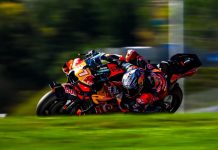
| My job title is communication manager, but the scope of the role goes far beyond writing press releases. My boss and I are responsible for all marketing and communication activities, from coordinating with sponsors to social media content, to briefings with our photographers… Before each round, I prepare all the event schedules so that the riders and team have their agenda, and then at the track we have PR events, rider meet and greets, garage tours, press releases, social media content. Let’s say that I’m constantly switching ‘hat’. I’ve been working with the team – which was previously the Kawasaki Racing Team and is now bimota – for 10 years. But I first started working for Kawasaki when I was about 20 – and I’m still here 25 years later! From a spark to a flame My dad was an amateur trials racer and mechanic, so I grew up around bikes and racing. I started trials riding just for fun when I was maybe 8 or 9, and then at 13, I started to race. I rode minibikes, scooters and then 125, 600 and 1000 bikes. I competed nationally, and towards the end I did the Barcelona 24 Hours, which was crazy! I was still racing when I went to college to study communication and marketing, and at the same time I was also working for a communication agency and doing a magazine-style motorsport TV show together with some friends. I was very busy! By the time I was about 20, it wasn’t easy for me to have the money to continue racing. So, I started to write articles for some Spanish magazines in exchange for a bike so that I could race that weekend. It was very hard to combine a job with racing. It would be hard even today. Becoming mum I was always incredibly busy trying to prove that I could be good at my job. And then I got pregnant, and everything stopped. Initially I was in shock; I didn’t know what to do and it was scary. I had to admit that it was impossible to continue racing, and that maybe my job would need to change. I started working at my dad’s company just to be closer to my son. And then I started to work with the Spanish WorldSBK broadcaster, as a commentator. The studio was in Barcelona, only about a 20-minute drive from my house. It was a big challenge, involving many hours of live TV so I really had to prepare, but it was good because I came to understand the WorldSBK championship. My son is 12 now and has never had a mum who’s always at home, so for him my job is totally normal. And I’m not away as much as people think. Each championship round means five days away, but then I’m home for two weeks. And at least half of our team members are parents, so meetings are never scheduled for 9am, which means I can do the school run each day when I’m home. And when I am away racing, my son is at home with his dad. I’m divorced, and my ex and I work out the calendar at the beginning of each year. It works well. My son rides, but I don’t like it! If he asks me whether we can go riding together, I say yes but there’s no pressure from me at all. He plays tennis and for me that’s perfect! Living the dream… I like every aspect of my job! The motivation comes from always trying to improve, not only on the technical or sporting side, but everywhere, from the food to social media to the guest experience. We’re always trying to do more, and this year the new bimota project has been huge motivation. It was challenging trying to keep everything secret, but I’ve really enjoyed it. And then my favourite part of a race weekend is when we are on the grid. That’s the best moment and we work hard for it. I worked hard my entire life to have my dream job, and now I have it. This is where I want to be. Working with very professional people around me. At this level, the riders are not just fast, they also understand the business of racing. My job, in communications, would be hard if they didn’t understand this. And not just the riders, but everyone on the team. You need to be like a real family and respect each other’s jobs. I’m super happy because the level of professionalism of every member of the team is incredible. We’re very lucky. The rough with the smooth Challenging situations exist whether you’re male or female. In my case, I’d say there were advantages to being a woman. When I was racing for example, I was the only woman there. And that made me stand out, which meant that journalists gave me the opportunity to write and earn money to race. As for being a female rider in a men’s world, perhaps you need to do more to prove yourself. I remember one time asking a mechanic to make a change to the bike but when I got on it, everything felt the same. And it turned out he was basically doing two clicks to the right and two clicks to the left, just to try and show everyone that I was asking for things but had no idea. That’s just how it is. You have to find the way. I also appreciate that as a woman, I’ve had some very good opportunities. Why did they call me to do TV commentary, for example? I wasn’t a WorldSBK expert. There were undoubtedly a lot of men better prepared than me to do that job, but they called me because I’m a woman. Experienced, yes, but they called me because I’m a woman. So, there are positives and negatives. WorldWCR: more women, more opportunity When I was kid, I felt like one of the boys and loved competing against them. I won a lot of races and was often the only girl competing. But now there are many more women who want to compete and they’re at a very good level, so it’s the right time for WorldWCR, for a women’s championship. And it’s good because a world championship means coverage, TV broadcasters, sponsors, support. So, your life as a rider is easier and there’s much more of a structure and a network than there was when I was growing up. I think the nice thing today is that riders have an option, so yes, there’s a dedicated women’s championship, but riders can also choose to run in a mixed category. Working your way up For anyone wanting to break into this industry, realistically, I think you need to start in a local or national championship and focus on really understanding the job. Begin at the beginning, rather than immediately aiming to be communication manager, for example. It doesn’t happen overnight – I’ve been working here for 25 years! Consider the way a rider reaches a world championship. They start in a local or national series, try to do their job and get some results. It takes time, and that applies whether you’re a rider, engineer or media manager. You need to work your way up step by step, doing your job properly because it’s the only way. A childhood dream come true… I never really considered working anywhere else, to be honest. If I wasn’t here, perhaps I’d have been a vet as I love animals, but I was always involved in this world and was racing by the time I was 13. I remember one time when my dad and I were at Valencia. We’d ridden from Barcelona with a group of people to watch the racing. It was raining hard, a disaster, and we were at the back of the back, mud everywhere. But I remember watching the race, pointing to the paddock, and telling my dad, “I’ll work here in the future, I’ll be here at this track”. I was 14 years old. Four years later, I started working for Derbi, so it took me four years to get there but I got there. |
- Advertisement -