


















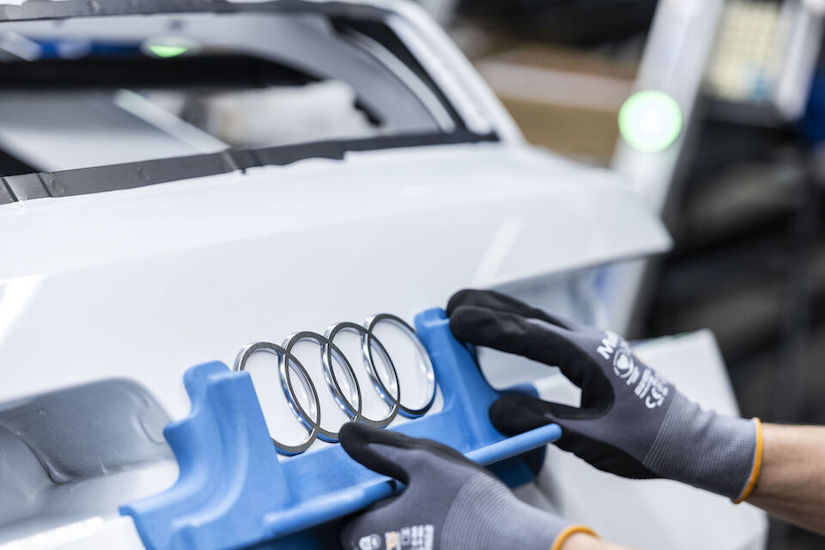
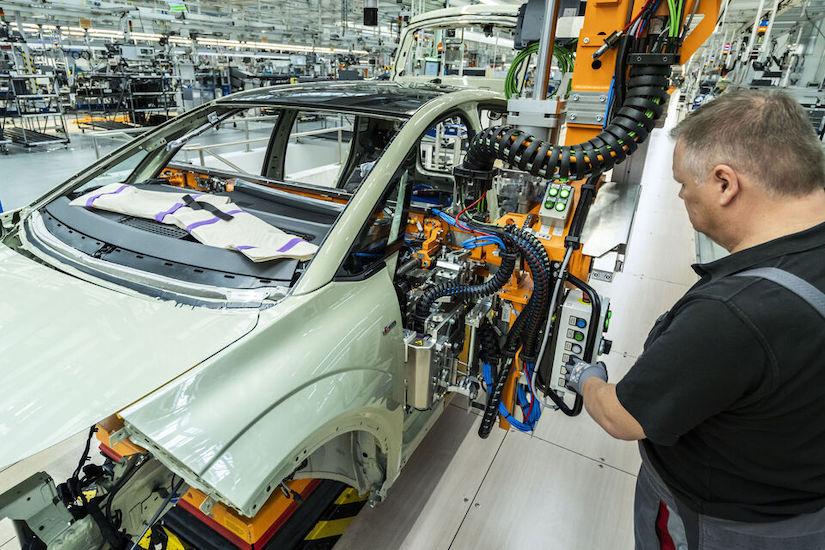
- Audi began production of the fully electric A2 e-tron at the Ingolstadt site
- The period from development to production readiness was 21 months shorter than for previous vehicle projects
- Fewer part numbers and the so-called string-of-pearls principle, among other measures, reduce complexity, space requirements, and logistics effort
- The use of the Audi Cloud “Edge Cloud 4 Production” marks an important step toward the fully connected factory
- AI assistants support employees in searching for information
Development time shortened by 21 months
Audi has significantly shortened its product development process for the A2 e-tron. The period from development to production readiness was 21 months shorter than for previous vehicle projects.
Experience from earlier vehicle projects and streamlined processes reduce the time and effort required for coordination and enable the vehicle to reach maturity earlier during pre-series production.
More efficient production through reduced complexity
Audi has significantly reduced complexity in the A2 e-tron. The model combines a high level of customer benefit with significantly fewer production-relevant part numbers.
This also significantly reduces the number of logistics supermarkets. As a result, less space is required for logistics, and material supply within the plant is simplified.
For the first time, Audi is applying the so-called string-of-pearls production principle in Ingolstadt, a principle already successfully used at the Neckarsulm plant.
The sequence of customer orders is determined six days before assembly starts and then processed across all production areas.
This type of factory control has several key advantages: among other things, it reduces process complexity because a fixed sequence allows parts to be produced directly at the supplier in the correct order and packed in the designated container.
In addition, Audi is increasing the cost-effectiveness of the production process because storage and sequencing areas are eliminated.
Flexible and resource-efficient
Audi manufactures the bodies of the A2 e-tron together with those of the Audi A3. This is made possible by the flexible layout of the facilities.
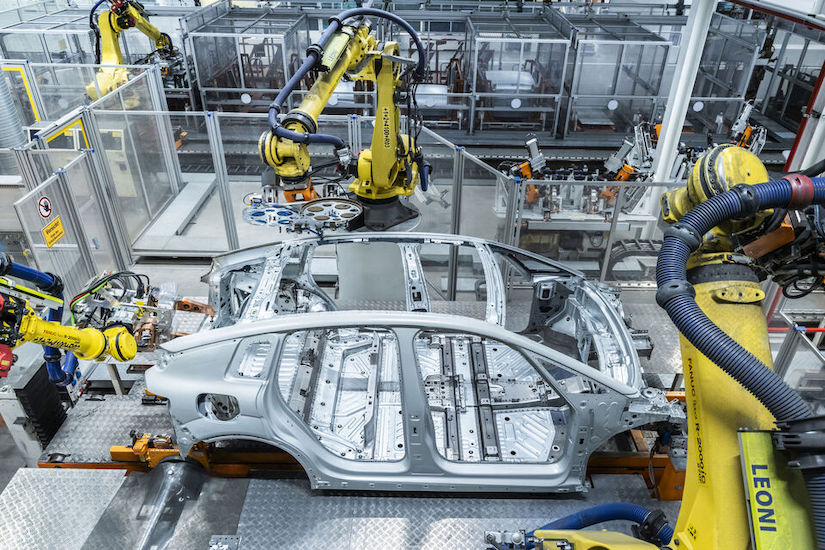
More than 1,200 production components, including robot welding guns and around 250 robots that have already been used to manufacture other Audi models, are being reused or put to further use.
A high degree of automation
Audi is bringing fully automated wheel installation to the Ingolstadt site with the A2 e-tron: fully automated robot stations are replacing the previous semi-automated bolting stations in the chassis preassembly area for the front and rear axles.
Audi is optimizing processes in the A2 e-tron body shop with so-called “bin picking”. Using image processing and camera-guided robot control, the intelligent technology recognizes and picks up components.
This can reduce ergonomically demanding tasks. For the first time, the robots can also remove small sheet-metal components directly from disordered containers and feed them into the next stage of the production process.
Audi Cloud and AI assistants
The industrial cloud “Edge Cloud 4 Production” supports the digital networking of assembly. The Universal Test System for commissioning the A2 e-tron control units and the so-called “operator guidance,” which provides information on vehicle customizations, are centrally controlled from the cloud.
This saves more than 450 industrial PCs in assembly.
Audi is also establishing a range of AI-supported (artificial intelligence) knowledge assistants across production sites. For example, the Supply Chain Chatbot helps employees search for expert knowledge, processes, and documentation.
The maintenance Chat supports maintenance teams with fault analysis and finding solutions.
A2 e-tron ensures skills for the future
In addition to technological innovation, the successful production launch of the A2 e-tron is the result of the targeted and early development of skills within the workforce.
With a multistage concept combining hands-on training and virtual qualifications, Audi prepared employees for the requirements of manufacturing the fully electric model.
This combines traditional practical modules on the assembly line with digital qualification concepts such as virtual assembly training on a screen.
The qualification program for the A2 e-tron strengthens electromobility expertise at the Ingolstadt site and sustainably anchors knowledge relevant to the future in the plant.
Continuous employee qualification is a key factor in the successful ramp-up of new technologies and the continued development of production.
Conclusion
The A2 e-tron is an example of the transformation of Audi production. Less complexity, a high degree of automation, and extensive digital networking demonstrate how Audi is advancing the transformation of its plants and sustainably strengthening competitiveness.
At the same time, people remain a central factor in success: modern technologies provide targeted support for employees in their tasks.