




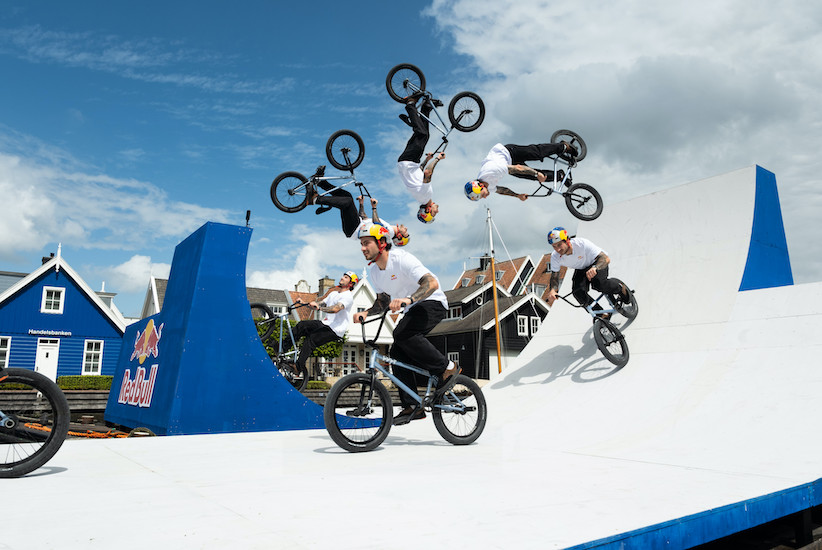
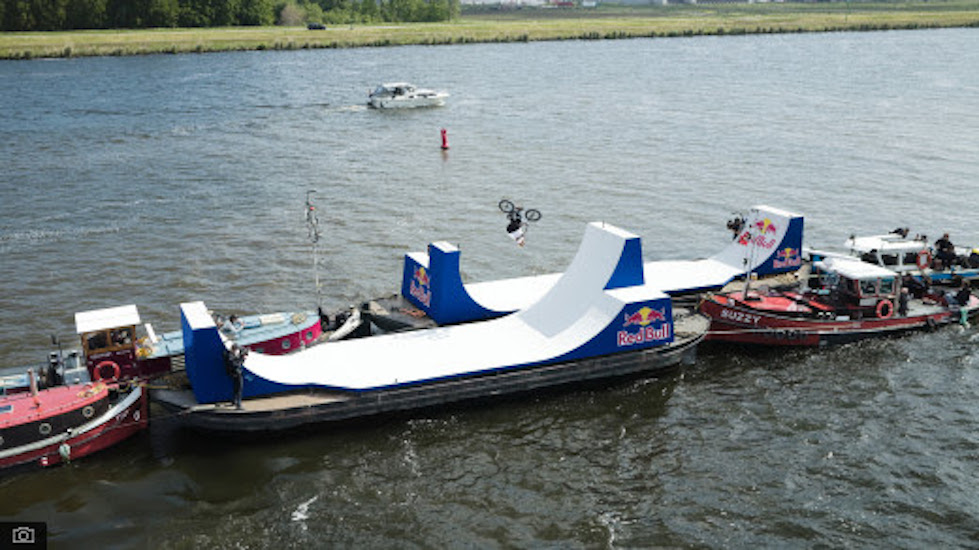
Red Bull athlete George Ntavoutian (Greece) has completed a world-first BMX open loop between two moving boats on Gooi Lake (Gooimeer) in the Netherlands, landing on a second vessel travelling in the opposite direction after launching from a ramp mounted on the first.
An open loop is a BMX trick in which a rider builds speed, rides upside down through a loop structure, and exits towards a separate landing. In Ntavoutian’s case, both the take-off and landing points were moving, turning a normally fixed setup into a moving-target calculation.
During practice, he measured approximately three seconds from drop-in (the moment he rolled down the take-off ramp to start the trick) to take-off (when he launched from the ramp into the open loop and became airborne).
That gave him only a narrow window to match his speed to the movement of the boats, commit to the take-off before the ramps were fully aligned, and trust that the landing would arrive while he was already upside down.
Watch George Ntavoutian’s open loop between two moving boats on YouTube.
Context
In a standard fixed loop setup, a rider can see the take-off, arc, and landing before dropping in. That gives clear visual reference points for speed, timing, and body position. On the water, those reference points changed from one attempt to the next.
Ntavoutian had to start the trick before the full setup was visually complete and the ramps were aligned. The take-off boat was moving forward, and the landing boat was moving away from him, while the gap between the two ramps changed as the boats crossed. The forward motion of the take-off ramp reduced the backward momentum the Greek athlete needed to reach the landing, forcing him to ride faster and pull harder than he would on a stationary setup.
The Netherlands was a natural setting for the project, bringing together the country’s extensive waterways, globally recognised cycling culture, and Ntavoutian’s personal history with Dutch BMX. As a teenager, he travelled there with his father, a mountain bike and road cyclist, discovered BMX at Area51 in Eindhoven, and later landed his first backflip in the country. A later visit to the Netherlands and its water landscape inspired the idea for a moving-boat loop project.
Ntavoutian had already established himself as a leading specialist in the discipline after completing a 7.5m full loop in Trikala, Greece, in 2024, a feat that earned him the nickname “Loop Master”.
On Gooi Lake, the challenge shifted from executing a known loop to performing it inside a dynamic moving system shaped by boat speed, water movement, wind, and ramp positioning.
Key Facts
- Project: Red Bull Boat Transfer – BMX open loop between two moving boats
- Athlete: George Ntavoutian (Greece) – Red Bull athlete
- Achievement: World-first BMX open loop with both take-off and landing ramps in motion
- Location: Gooi Lake (Gooimeer), near Huizen, the Netherlands
- Date of Feat: 05-06-2026
- Setup: Two boats travelling in opposite directions with BMX ramps mounted on board
- Boat Gap: Approximately 1 m during the crossing
- Previous Loop Feat: 7.5m full loop in Trikala, Greece, in 2024
- Time From Drop-In To Take-Off: Approximately 3 seconds, according to Ntavoutian’s practice timing
- Core Technical Challenge: Committing before the landing ramp was fully in position
- Variables: Boat speed, boat line, ramp gap, wind, waves, water movement, rider speed, and timing
- Technical Demands: Misjudging the timing, losing backward momentum, or missing the landing transition
Performance Overview
- Stationary Setup Test: Ntavoutian tested the loop while the boats and ramps were stationary, allowing him to understand the base speed, pull, and landing position.
- One-Boat Moving Take-Off Adaptation: Once the take-off ramp on one boat began moving, the trick changed, as Ntavoutian could no longer rely on the same visual confirmation he would have in a fixed setup.
- Two-Boat Crossing: With both boats moving in opposite directions, the three-second window from drop-in to take-off became decisive. The boats had to hold the right speed, spacing, and line as Ntavoutian committed to the take-off.
- Open-Water Conditions: Early canal tests felt close to riding on land, but open water introduced stronger wind, waves, and boat instability. The boats sometimes struggled to stay close enough or maintain the required speed, leading to one attempt where the boats collided while Ntavoutian was performing the trick.
- Momentum Adjustment: Because the take-off ramp was moving forward, Ntavoutian needed more speed than on a stationary setup. Without enough backward momentum, he risked staying too still in the air rather than travelling back towards the landing.
- Commitment Point: Ntavoutian had to drop in while the take-off and landing were not yet aligned. At that moment, the landing was beside him rather than behind him, requiring him to pull back and trust that the ramp would be in place by the time he exited the loop.
- Final Execution: To compensate for the forward movement of the take-off ramp, Ntavoutian rode faster than on the stationary setup and pulled harder to generate enough backward movement toward the landing boat.
Athlete Quotes
George Ntavoutian, BMX Rider: “I cannot compare the experience to anything; I have never done anything like this. I pretty much had to forget everything I typically do and do something new. Go faster, pull harder, timing, everything was just new.”
“Having to drop in before the take-off and landing were aligned was challenging. I was on the take-off ramp while the landing was right next to me, and yet I had to send myself backwards, trusting that the landing would be there when I came out of the loop. The hardest part was adapting my speed to the boat’s speed first and then trusting the timing, the decision to drop in, and the commitment. [During practice,] every time I was dropping in, my body was telling me that it was the wrong timing.”
“Doing this on the canals in the beginning felt like being on land, but when we took the boats to open water, the wind was crazy. It did not really affect me, but it affected the boats trying to find the line and speed. We had lots of failed attempts because the boats could not keep up with the speed or stay close enough to each other. Sometimes they were even crashing into each other. There was one try where I was doing the loop, and the boats crashed while I was on the trick.”
Why It Matters
Ntavoutian’s open loop between moving boats stands out because it turned a controlled BMX skill into a moving-target calculation. Instead of reading a fixed take-off and landing, he had to start before the ramps were fully aligned, generate the right speed for a platform already moving beneath him, and trust that the landing would arrive as he exited the loop.
The technical difficulty came from the number of variables changing at once. Boat speed, ramp spacing, wind, waves, and water movement all affected the line, while the forward motion of the take-off ramp reduced the backward momentum Ntavoutian needed to reach the landing. The loop lasted only seconds, but success depended on synchronising rider timing, boat positioning, and momentum before he passed the point of no return, when braking, correcting his line, or abandoning the trick was no longer possible.