












After a promising start to her 2026 WorldWCR campaign, French rider Lucie Boudesseul’s season was derailed by a major crash while competing in a French SBK Championship round at Nogaro in May. The accident resulted in a fractured left foot and a spinal injury requiring complex surgery, including the insertion of implants and screws. Several months on, Lucie and her coach, David Veillon, reflect on her recovery and share an insight into their training methods, including her work with a cutting-edge motorcycle simulator conceived and designed by former world champion Àlex Crivillé, and developed with the support of David’s company, DVS. While the machine helps Lucie to develop as a rider, she, in turn, contributes to its evolution.
Lucie: My WorldWCR season didn’t begin as we’d hoped because I had two crashes, at Portimão and Assen, but the podium in race 2 at Assen gave us a ‘second breath’ because you feel much better and more confident after a podium. Then came the crash at French circuit Nogaro, and for a month and a half I couldn’t do anything at all.
David: When it came to Lucie’s recovery, it started with determining where she was physically. It’s about getting back in touch with the body, understanding it and accepting it. And we tried to work at Lucie’s own pace and show her that, despite the injury, she could still do certain things. We worked with her physiotherapist and adapted the simulator so that she could work in a more controlled way, almost in a locked position, so as not to put too much strain on her back.
Lucie: It took me about two months to get back on the simulator. Physically, it was great because I was reactivating the muscles used for riding a motorcycle. And mentally too, because I had the feeling I was riding again, but without any danger or risk. I could do something positive and keep moving forward. I do different physiotherapy and rehabilitation work each day, including physiotherapy in the pool, which allows me to work on mobility I wouldn’t normally be able to achieve on land. I have some pretty intense days, but at least I can work on a little bit of everything and gradually get my body back into exercise.
David: What’s important is that Lucie listens to her body. She adapts everything to who she is and how she feels on that particular day. From the very beginning, she has been the one making the decisions. I’ve simply guided her.
One of just 50 such simulators in the world, the motorcycle simulator Lucie uses is a unique training tool available to her at her local gym, where it has helped her refine her technique and improve her riding.
Lucie: The simulator helps me stay in shape between the races with specific motorbike training, because I can’t train in real life as much as I’d like. It’s really helped me with my position, coordination, balance, and I can also train at any track I like. You train your strength in the same way as you do on a real bike, but the simulator’s even harder for the muscles because you don’t have inertia, just gravity and your weight so 20 minutes on the simulator is like 30-40 minutes on a bike. In WorldWCR, the most difficult thing for me is that I still have a riding style suited to a 1000 cc bike, and there’s little time to alter this over a race weekend. So, the simulator also helps me to adapt to the R7.
David: All the work we do on the simulator with Lucie, in terms of posture and body support, has allowed us to discover her style. She’s a rider who loads the front a lot, she is very free through the upper body and can stay relaxed while breathing. We have seen progress in her speed and load transfer and she’s really developed both her vision and her technique on track. Simulator training can also help to open the doors of the mind: developing confidence, working on choice, doubt, decision-making — all these little things that are essential for a rider’s wellbeing. The other goal is for the body to be completely ready physically, so that the rider has time to think. The more time you have, the faster you go.
Lucie: In the end, every rider can be in good shape and get strong by going to the gym. That’s not so hard to achieve. For me, it’s more about the coordination, the explosivity, the balance, using your strength in the right way. We only spend a tenth of our time actually racing; everything else is preparation. And that’s what really matters – all the preparation, whether physical or mental, even nutrition, everything that is put in place behind the scenes.
Lucie also understands the importance of mental preparation and works with a specific coach.
Lucie: Another aspect of my training is the psychology. I have a mental coach so that I won’t feel pressure before the races and can just enjoy what I do. Competing in the world championship is my childhood dream, so perhaps I’m a little too enthusiastic at times. I’ve learned not to think too far ahead and just focus on the here and now. I think sometimes the mental training is harder, because every athlete can go to the gym and train physically, but in the end it’s your brain that gives you the condition in the moment.
David: You shouldn’t be afraid to step outside your comfort zone. Always keep an open mind and, above all, remember that we are human beings. We’re not machines. We have strengths and weaknesses, and we adapt and adjust according to what we have.
Since Lucie first began racing in 2018, David has been by her side as both her mechanic and mentor, helping her develop her riding style and refine her technique, while their shared work on the simulator continues to push the boundaries of performance.
Lucie: David comes to all my races because he’s also my mechanic!
David: Working on Lucie’s bike as a mechanic allows me to understand a little better how everything works. It also reassures her. It’s a question of trust. She feels reassured knowing that I’m doing the mechanics, and I feel reassured too. It also allows me to adjust the simulator settings to match the performance of the R7, so that it is as representative as possible.
Lucie: I’ve worked with David since 2018. He’s essentially taught me to ride as I ride now. My riding style, my level, my technical ability, it’s all down to him. Then the more you race and the better you get, the focus shifts to the details. And we carry out this refinement work on the simulator too. I actually work with David in his company, riding the machines and helping with development.
David: Lucie has a very strong feel for the bike. When we talk about a rider dancing with their motorcycle, that’s exactly what she brings. With the simulator, the challenge is to precisely identify things, including any faults. Lucie brings a very objective approach, and, through her input, we’ve been able to develop the machine we have today. In terms of the front end, the support and the transfer of load, she has really brought a lot to the table. A certain level of rigour. We are currently moving to a new generation of technology, and that is largely the result of all Lucie’s hard work.
Yet Lucie’s training goes far beyond motorcycle training and simulator work. Lucie likes to incorporate many different activities into her training, often inspired by David’s insight and suggestions.
Lucie: I think many sports can support my riding, in that each discipline requires balance, footwork, coordination… I really enjoy boxing, for example, which I’ve been doing for over a year. You need to be balanced, very focused, get the footwork right. It also helps me work on my level of aggression, important in racing because you need to be aggressive but calm. Tennis is similar because you need to be explosive but also balanced, with the coordination and ability to anticipate the ball.
David: Exactly. Boxing, for example, compared with motorcycling, is all about energy transfer – transferring energy at the right moment, without any latency or hesitation. That’s what boxing is about. Explosiveness is also a key part of it. The speed of the gaze. Learning and developing peripheral vision. All these things: sharpening, strengthening, optimising.
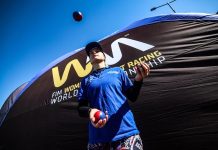
Lucie: David always has a lot of different ideas. He’s always the first one to say, maybe you should try this exercise or this kind of sport? He’s encouraged me to try many things – boxing, swimming, juggling, tennis. I don’t really have one favourite sport. For me, it’s more about taking time for myself and feeling that I’m constantly improving. That’s what I enjoy. With tennis you must react to someone else and with boxing you have to anticipate the other person, and I like this contact with an opponent.
David: My method of training is based on the individual and their potential to develop. I observe people and try to work on their wellbeing, on the body, on breathing. The idea is for the person to be able to better appreciate everything they discover about themselves and get used to having all these elements working together on the bike. So, when you work on your balance through juggling, for example, you experience a sense of enjoyment when you get it right. You’re having fun, but you’re also achieving something. That’s the idea behind play as a teaching approach, and it’s why athletes often train in groups, learning from one another along the way. It’s a continuous process of learning and improvement – for Lucie too.
Lucie: As we said earlier, it’s all about preparation. When you run a marathon, race day is simply the culmination of all the work you’ve put in beforehand. And it’s exactly the same here.