











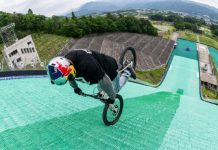


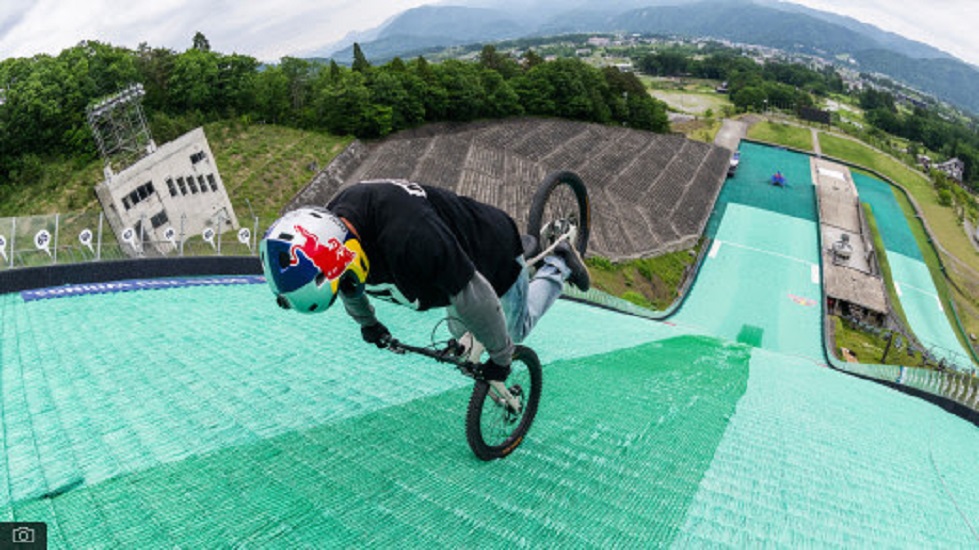
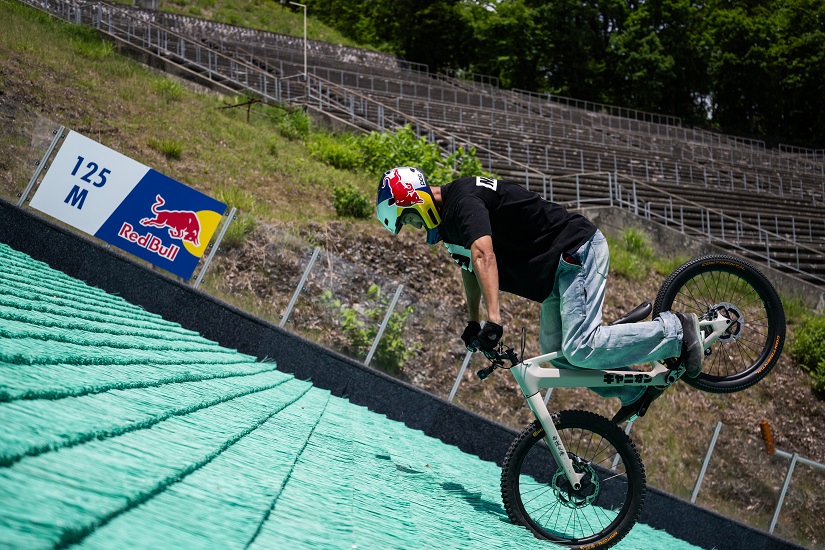
Japanese trials champion Tomomi Nishikubo has achieved a landmark moment in action sports, becoming the first athlete to descend an Olympic ski jumping hill performing a full fakie nose manual. The feat took place at Hakuba Ski Jump Stadium in Nagano, where Nishikubo rode backwards on a single wheel down one of the steepest and most iconic structures in winter sports. Here is all you need to know:
- Nishikubo completed the descent on gradients reaching 37.5 degrees while maintaining a fakie nose manual throughout, balancing exclusively on the front wheel while riding backwards. Over a 136.6-metre course, he sustained the position for 35 seconds, demonstrating exceptional precision and control under continuous load.
- Speeds approached 60 km/h during the descent, significantly increasing the technical difficulty and physical demands of the trick. Brake temperatures reached approximately 150°C, with rotors and pads burning out repeatedly during the final phase of the project.
- The project was developed over two years from initial concept to completion, driven by Nishikubo’s dream to perform his signature fakie nose manual somewhere “truly outrageous.” After scouting the venue in August 2024 and failing in his first attempt in June 2025, he spent months solving grip and braking issues to make the run possible.
- To recreate the conditions as accurately as possible, Nishikubo built a 10-metre replica practice hill matching the jump’s 37° maximum gradient and used the same brush material as the actual ski jump. There, he tested four different 24-inch tires and ultimately developed custom-studded MTB tires to improve grip even further.
- One week before the challenge, Nishikubo returned to Hakuba to test his findings, discovering that wax residue on the ski jump surface still limited traction. Standard MTB tires lacked grip, studded tires were not permitted by the venue, and installing approximately 30 metres of netting allowed the tires to grip even on the steepest section.
- Following these tests, the crew spent four days installing approximately 100 metres of netting down the hill, which solved the grip problem but introduced a new challenge. The increased traction generated so much braking force that the brakes began overheating, with rotors and pads burning out after long runs and needing repeated replacement.
- On the final day, Nishikubo switched from resin brake pads to metal brake pads, which handled heat much better despite offering less initial bite. Instead of obsessing over braking points or body position, he decided simply to enjoy the incredible opportunity in front of him, a mindset shift that allowed him to land the run.
- The official attempts and production scale reflect the intensity of the challenge, with Nishikubo logging 50 full-course attempts with cameras rolling (35 in 2025, 15 in 2026). The project was supported by a 20-person production crew, nine cameras (including drones and GoPros), while equipment sacrificed included two handlebars, two stems, 11 brake sets, and six different tires tested.
- The physical toll on Nishikubo included 10 abrasions, five burns, five heavy bruises, and two jammed fingers over the course of the project. The successful run also resulted in two new Guinness World Records.
Watch Tomomi Nishikubo’s World Record feat now on Red Bull Bike YouTube.
KEY FACTS:
- 2 years from concept to completion
- 50 full-course attempts (35 in 2025, 15 in 2026)
- 37.5° maximum gradient
- 136.6 m travelled backwards on one wheel
- 35 seconds balancing exclusively on the front wheel
- Over 60 km/h top speed
- 150°C brake temperatures
- Advertisement -