



From spectator to insider…
As a child, I used to watch all the racing on TV, every session from free practice to the last race of the day. My family and I moved to Spain from Argentina, and, in 2005, I convinced my whole family to go and watch the Valencia MotoGP. Once I got inside the paddock, I knew I had to work in this world – I think I was 15.
My first official role in the WorldSBK paddock came in 2014, in the European Junior Cup. Series Director Gerry Bryce had seen me helping a French team in Yamaha Superstock 600 and 1000. I’d also been a grid girl, and once you do that some people tend to pigeonhole you and think you can’t do anything else.
So, I was very thankful to Gerry because he gave me the opportunity to prove myself. I think I was about 23 when I started working with riders who were just 14 to 20. Some thought I was a fellow rider, because I looked pretty young!
Polyglot and problem solver…
People have different talents, and I think mine is speaking a few languages. I started learning English from a very young age with my mum. She taught young children, so I started learning with her. Then I studied French for a couple of years at school in Spain, just one class a week. Later I had a French boyfriend, and I learned more of the language living with him in France. As for Italian, I’ve never studied it and just picked it up in the paddock really.
I think our personality can differ depending on the language we’re speaking, and I find I can explain certain things more easily in a language other than my own. My Instagram header reads “professional problem solver”, and it’s probably thanks to the languages I speak that I’m good at finding solutions. My language knowledge has been very important for me in terms of opening doors. Of course you must be ready to work hard too, and I was lucky to gain paddock experience at a very young age.
Moving on up…
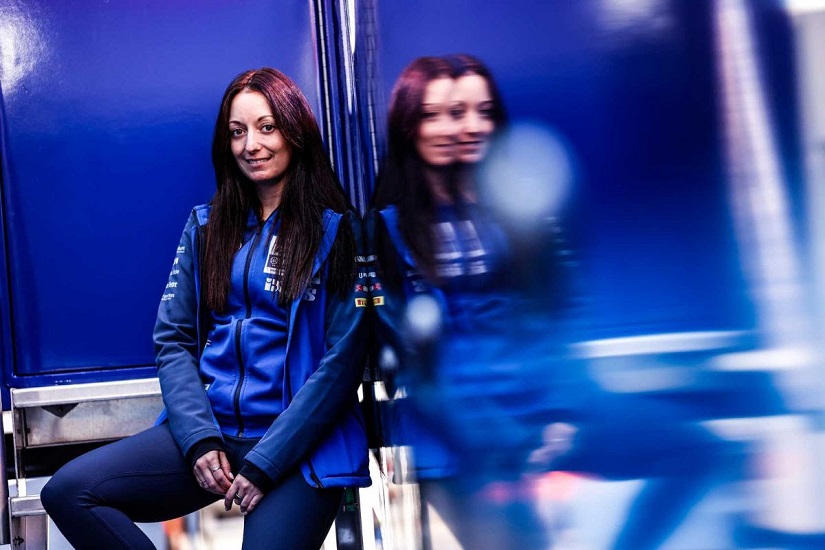
In 2018, some of my friends at GRT Yamaha told me that the team was looking for a team coordinator with my profile and paddock experience. I met with Team Principal Filippo Conti at a test in Jerez and that was that. And here we are 8 years later.
My role started small and then developed in every direction. I’m good at communicating and am very determined – when I start something I finish it! And I think that’s something I developed working here, because it’s a fast-moving sport, and everything needs to be done here and now. Even more with the team coordinator role. You’re like a mum to everyone.
Coordination was especially challenging during the pandemic. Managing all the flight and hotel changes, the different COVID test rules in each country. Our riders, Garrett Gerloff and Kohta Nozane, came from the US and Japan respectively and needed completely different documents to travel. It was a crazy time, and I’m glad it doesn’t happen every year.
But day-to-day it’s like a puzzle and you must fit all the pieces together to ensure everyone on the team gets to the race at the same time. At one point, we had about eight different departure airports, and there can always be last minute changes that might impact on the plans of the whole team, so it’s not easy.
I’ve been sponsorship manager for the last year. My bosses like the way I look after people, and the sponsors appreciate having someone they can rely on if they want to develop anything with the team. Many of our sponsors have been with us for years and we’ve built relationships characterised by mutual trust. If they want to make changes, I’ll do all I can to make things better. I like making people happy!
Progress, persistence, and possibility
Working here has completely taken me out of my comfort zone. I’m quite proud of myself for coming into this male-dominated sport and getting to where I am today. I used to be quite introverted, but I’m now more sociable and feel braver, stronger, less insecure. And I realise that there’s no limit to what we can do!
As women, we were a lot more limited in the past because we were deemed to only fit certain roles. But now we see women working as mechanics, as engineers, as team managers. Look at the BbKRT team; I think they really set an example in terms of how many women they employ. Our own Terra & Vita GRT Yamaha WorldWCR team too, where the two riders are supported by two female mechanics. We are doing our best to help them gain experience so that they can hopefully find work with a Superbike team in a couple of years. As for me, this is my eighth season with GRT, I switched role after six seasons, and I don’t see why things couldn’t change again in a couple of years – anything can happen!
A starting point, not the finish line
It’s funny because a few years ago, no one would sponsor a woman rider – it’s crazy for me to think that you have the chance to be the first to bring a girl to the top of the world and you’re not doing it. Charlotte Tilbury sponsors an F1 Academy team, and I don’t see why similar brands that support women in their everyday lives wouldn’t want to support women in racing too. We need to open these doors, and I hope WorldWCR can serve as a platform for female riders to get more support.
I think women can compete in mixed classes, though there’s a lot of work to do. WorldWCR is just the starting point. Maria Herrera has competed in MotoE for example, which is hard because the bikes are heavy, and in Moto3. You really need to have a shot with a good team and a good bike if you want to prove yourself though. I don’t think she necessarily had the best chances, but she’s an amazing rider and has shown she can be as fast as any male rider.
Where work becomes a refuge…
Everyone who works in motorsport sacrifices things to be here. Is it worth it? 100% yes. I lost my sister three years ago and my job here helped me through it. I was able to focus on my work, and I felt supported by my colleagues and friends in the paddock.
Few things in life are as difficult as losing a loved one, but having this job that distracted me and took me around the world helped, I think. And I felt very lucky to have that, so yes, we make sacrifices, but from my perspective, the work can even help when we’re going through a tough time at home.
My best friends at home are still my best friends today. If someone wants to stay in your life, they will make the effort to stay in touch and so will you. I also have close friends in the paddock, like Elia Ramello (Team GoEleven).
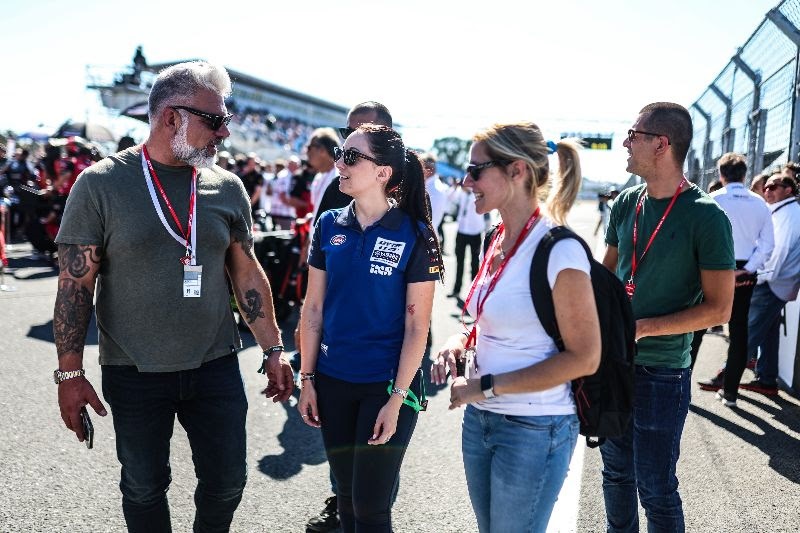
I met him when he was maybe 12 and it’s incredible to think we’re still friends now. Our friendship’s only grown stronger because we understand each other and can rely on each other at work. I also get on very well with Chiara Mancini, my teammate. We support each other, we don’t compete, and I think that’s a really positive aspect of life in the WorldSBK paddock, in that all the women are here for each other.
Coming home…
I think it takes a special type of personality to work in the paddock; it’s not for everyone. I’ve had friends who’ve tried and given up after a year or two because they couldn’t cope with the pressure or being away all the time. I think those of us who carry on working here are made different.
WorldSBK is a very fan-friendly paddock where you really see the people enjoying themselves, the riders talking to the fans, I don’t think it’s appreciated enough from the outside. Take the paddock show: Michael Hill’s always there giving his best however big the crowd is, and that’s something I wish more people would talk about so as to bring new fans to the championship. Some of our sponsors don’t know this world but once they experience it for themselves, they really appreciate what it means.
I never considered anything else as a career. I was very, very determined to work in motorsport, any discipline really. But I’m very happy I found WorldSBK, which is my home now. I am myself when I work here, and don’t need to pretend to be someone else.