
















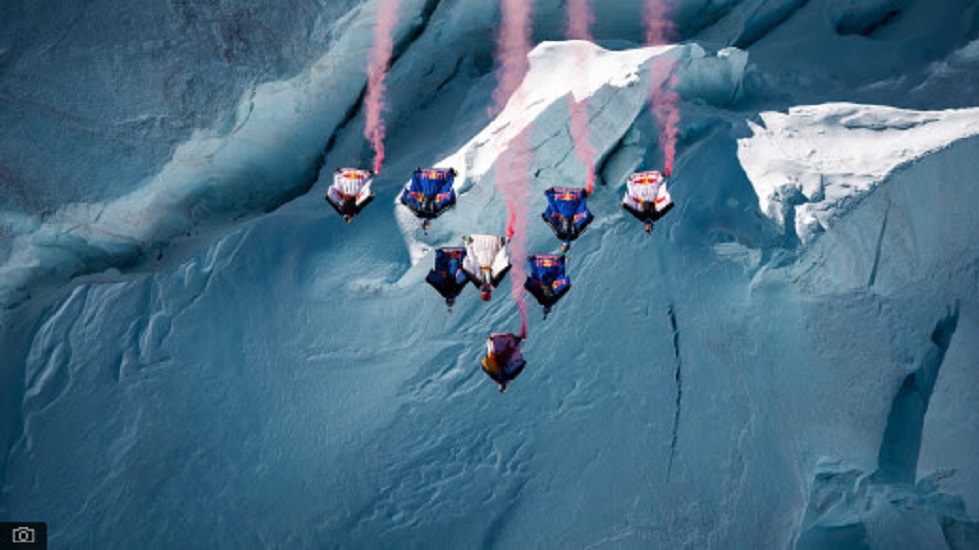
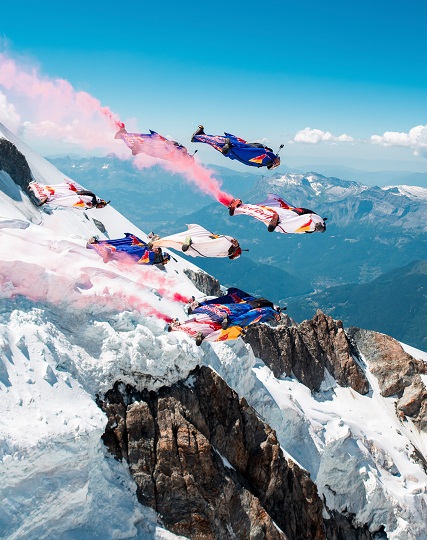
Led by Fred Fugen and Dani Román, the achieved feat combines elite performance, precision teamwork and a continuous aerial line captured from within the formation. The overall project was two years in the making and brought together an international crew of athletes and camera flyers to execute one uninterrupted formation flight at extreme altitude, and a world first. Here is all you need to know:
- Fred Fugen, who previously delivered the longest terrain wingsuit line ever flown over Mont Blanc, returned to the mountain with a new idea: to transform an already historic line into a collective formation flight that could be experienced from the inside. For Fugen, the achievement was as much about assembling the right people and building the right trust as it was about flying the line itself.
- “The goal of this project was to reunite a group of expert wingsuit pilots and to fly together above Mont Blanc, in Chamonix where I live, and to do some very technical flights together and achieve a world first. It has been a dream to get this kind of team together”, says Fred Fugen.
- Fellow aerial athlete Dani Román played a key role in flight as the second leader, helping guide the second group while staying connected to the movement of the main formation. His role added precision and flexibility to a flight that depended on timing, communication and complete awareness from start to finish.
- The crew brought together elite athletes from France, Spain, Austria, Chile and the USA, creating an international line-up that reflected the very highest level of wingsuit flying. The group included Fred Fugen, Dani Román, Marco Fürst, Marco Waltenspiel, Aurélien Chatard, Sebastian Álvarez, Mike Swanson and Andy Farrington, with each athlete bringing proven experience in technically demanding aerial projects.
- The project had been in the making for two years, with detailed planning, testing and coordination taking place long before the flight itself. Every stage had to be considered carefully, from the positioning of the athletes to the timing of the formation and the margin needed for a safe landing.
- The flight started above the summit of Mont Blanc and finished in the Chamonix Valley, turning one of Europe’s most iconic mountains into the setting for a landmark terrain formation. The route combined altitude, distance and technical flying in a way that pushed both performance and precision to the limit.
- The crew covered 7.5 km horizontally and about 3,800m of terrain flying from summit to landing, completing the full sequence in roughly 3 minutes and 30 seconds. Flying at speeds of around 180 to 200 km/h, the athletes had to remain locked into their positions while reading the terrain and managing the formation in real time.
- “The biggest challenge flying here is to always keep some margin to be able to land safely. Once we jump from the helicopter, there is almost no place to land until we reach the valley at the bottom”, explains Fugen. “We have to manage the line and the flight all together while doing some technical moves but still be able to have enough altitude to open the parachute safely and land together on the ground.”
- Two professional air-to-air camera flyers flew alongside the athletes to capture the action from within the formation rather than from outside it. That perspective gives audiences a closer look at the speed, spacing and control required to fly in close terrain, while making the final footage feel more immersive and immediate.
- The flight was completed as one continuous line, which gave the project its defining shape and reinforced the level of discipline needed to execute it successfully. The formation also split into two four-athlete groups before rejoining, adding another layer of technical challenge to an already complex flight.
- The project was built on trust, communication and collective commitment, with every athlete relying on the others to hold position and respond instantly in the air. That interdependence is part of what makes the flight resonate beyond the sport itself, because it is as much a story of teamwork as it is of athletic progression.
- The result is a unique point of view of Mont Blanc that reveals the speed, control and collective focus behind a world-class wingsuit performance. In Dani Román’s words: “Definitely a jump like this, a world first over Mont Blanc, with this group of friends, is a once-in-a-lifetime, huge achievement for all of us. To describe the experience in a few words is pretty hard, but I can say it was beautiful, it was wild and it was very intense. Best jumps of my life.”
KEY FACTS
- Project: Longest wingsuit formation terrain flying over Mont Blanc
- Location: Chamonix, France
- Horizontal distance: 7.5 km
- Terrain flying: Approximately 3,800m from summit to landing
- Total altitude including helicopter drop: Approximately 5,500m
- Flight duration: Around 3 minutes and 30 seconds
- Speed: Approximately 180 to 200 km/h
- Formation detail: One continuous line, with a split into two four-athlete groups before
ATHLETES
Fred Fugen (FRA)
Dani Román (SPA)
Marco Fürst (AT)
Marco Waltenspiel (AT)
Aurélien Chatard (FRA)
Sebastian Álvarez (CHI)
Mike Swanson (USA)
Andy Farrington (USA)
CAMERA TEAM
Vincent Cotte (FRA)
Scott Palmer (USA)
- Advertisement -