

















Two-time downhill champion earns Guinness World Records™ title for the fastest skateboard speed achieved in a standing position.
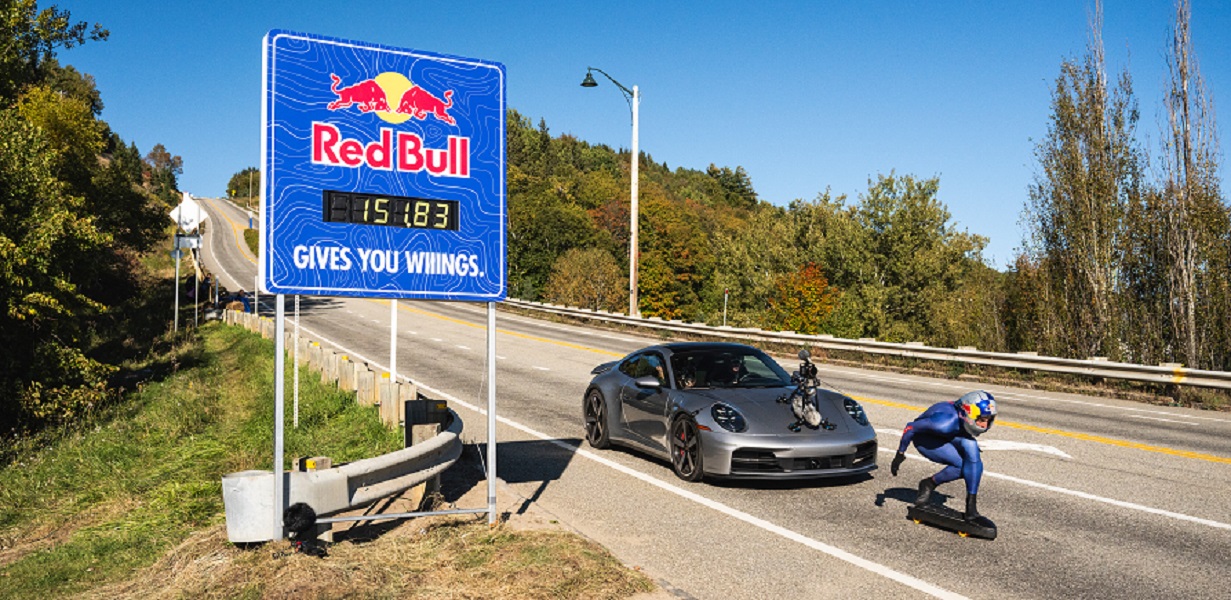
Red Bull athlete Diego Poncelet (Spain) has become the fastest skateboarder in history, reaching 151.83 km/h (94.34 mph) and achieving the Guinness World Records™ title for the fastest skateboard speed achieved in a standing position.
The 27-year-old two-time downhill champion broke the existing record by a small margin on his first day of testing, reaching 146.88 km/h. Poncelet knew there was potential for more, but with wind speeds far from ideal, he was forced to wait another five days for the right conditions.
He then returned to Route du Port in Les Éboulements, in Quebec’s Charlevoix region, and pushed the benchmark beyond 150 km/h.
The record-breaking run took place on 22 September 2026 on a closed section of the road, in the presence of a Guinness World Records™ adjudicator.
Watch the run that made Diego Poncelet the fastest skateboarder in history on YouTube.
Context
The achievement was the result of years of preparation across aerodynamics, physical conditioning, equipment development, road analysis, and meteorology. Poncelet’s objective was not simply to improve the existing record, but to explore whether a standing skateboarder could exceed 150 km/h while remaining stable enough to control the board.
His interest in speed began before he discovered downhill skating. Early ambitions to become a Formula One driver merged with his passion for the rebel culture of skateboarding, eventually developing into a pursuit of speeds rarely associated with the sport.
Key Facts
Achievement: Guinness World Records™ title for the fastest skateboard speed achieved in a standing position
Athlete: Diego Poncelet – Spain, 27 – Red Bull athlete, two-time world downhill skateboarding champion
Record Speed: 151.83 km/h (94.34 mph)
First Testing-Day Speed: 146.88 km/h
Date of Record: 22 September 2026
Location: Route du Port, Les Éboulements, Charlevoix, Quebec, Canada
Road Length: Approximately 2.2 km
Maximum Gradient: 18% decline
Straight-Line Section: Approximately 600 m
Record-Run Wind: 10-14 km/h tailwind from the northeast
Verification: Guinness World Records™ adjudicator present
Preparation: Wind-tunnel testing, meteorological analysis, physical conditioning and aerodynamic development
Performance Wear: Textured aerodynamic speed suit with back spoiler technology; seamless 3D-knit aerodynamic footwear and optimised gloves and pucks developed with Prada Linea Rossa
Performance Overview
First Record Run – 146.88 km/h: Poncelet broke the existing record on his first day of testing but remained short of his personal target of 150 km/h.
Five-Day Weather Hold: Unfavourable wind conditions prevented another attempt, forcing Poncelet and his team to wait for a suitable weather window.
Final Run – 151.83 km/h: With a 10–14 km/h tailwind from the northeast, Poncelet returned to Route du Port and exceeded 150 km/h, setting the new Guinness World Records™ benchmark.
Route – Approximately 2.2 km: The road reaches an 18% decline at its steepest point, including approximately 600 m of sustained straight-line descent.
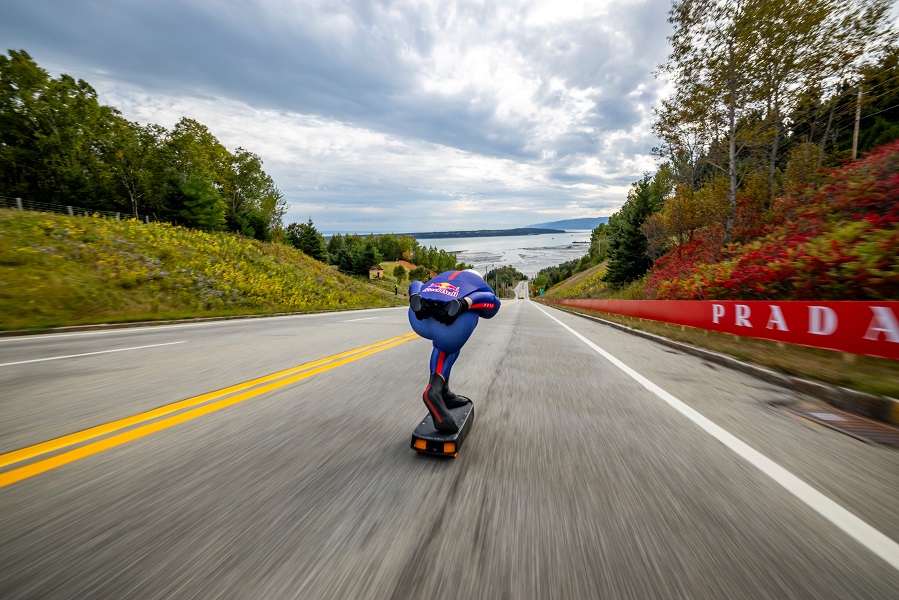
Control at Speed: From his compact aerodynamic position, Poncelet relied on subtle movements to control speed and stability, crouching to accelerate and standing to slow down.
Combining Instinct, Science and Skill
Poncelet’s record-breaking descent went beyond riding technique. Sessions in a Geneva wind tunnel refined his posture and established how long he could maintain his aerodynamic position before his body started to give.
Physically, he set out to be as heavy and as lean as possible while remaining streamlined. He improved the mobility of his torso and trained his neck to bend until it touched his knee, shaping his body like a wing to maximise aerodynamic efficiency.
At full speed, Poncelet could barely move without risking instability on the board. He relied on subtle body movements to work with the airflow, crouching to accelerate and standing to slow down.
Unable to see clearly ahead from his compact position, he navigated using his memory of the road and the painted white lines. Every corner was memorised in advance and ridden on instinct because, at high speeds, a corner could arrive before a conscious decision could be made.
Years of Development and Innovation
Every element of Poncelet’s set-up was selected for speed and performance.
His suit used textured fabrics designed to help the air remain attached to his body instead of breaking away behind him, reducing the turbulent wake that created aerodynamic drag. A spoiler structure on his back allowed him to tuck his hands underneath while providing the airflow with a defined separation point.
Prada Linea Rossa worked with Poncelet to design and develop his footwear and gloves. The seamless 3D-knit aerodynamic shoes featured an asymmetrical design that maximised stability at the front while minimising air resistance at the rear.
An inner sole using D3O technology helped dampen vibrations from the road, while an integrated rubber sole lowered his position and maintained grip on the board. The optimised gloves and pucks provided a clean cut-off point for the airflow while ensuring Poncelet could place his hands on the ground to drift in an emergency.
At the heart of the attempt was Poncelet’s signature 9.81 Skateboards pro model, a board he had ridden on roads around the world. Fitted with Seismic wheels, bearings and grip tape, it was encased in a custom aerodynamic carbon-fibre fairing for the record attempt.
Finding the Right Road
Finding the right road was a crucial part of the process. Poncelet spent years searching for and testing potential locations, from Austria and Ireland to Canada, assessing each road for its gradient, surface, length and conditions.
Route du Port in Les Éboulements was ultimately selected for the feat. The road reaches an 18% decline at its steepest point, sustained over approximately 600 m of straight-line descent, and is around 2.2 km in length.
The location also carried historical significance: British downhill skateboarder Pete Connolly had set the previous world record on the same hill in 2017. He passed away from cancer in 2025, and the project has been a tribute to him since.
The Right Team and the Right Conditions
Poncelet was surrounded by friends, family and mentors throughout the project. Industrial engineer and former world champion skater Martin Siegrist analysed Poncelet’s position and designed 3D-modelled aerodynamic fairings to reduce air resistance.
Friend and fellow rider Grégoire Schab drove the Porsche 911 chase car used to document the feat. At such high speeds, precision driving became an important part of the operation. Porsche supplied both the Porsche 911 and Porsche Cayenne Electric safety car, while supporting driver training for the attempt.
Only the wind remained outside the team’s control. Reading the weather conditions fell to Miguel Sánchez Cuenca, Poncelet’s meteorologist uncle, who works at the elite levels of America’s Cup sailing.
The geography of the Charlevoix road, which sits in a valley alongside the St. Lawrence River estuary, meant wind direction could affect both speed and stability. A short window of 10–14 km/h tailwind from the northeast ultimately provided the conditions used for the 151.83 km/h run.
Quotes
Diego Poncelet, Spanish downhill skateboarder and two-time downhill champion: “I never truly admitted to myself that my real objective was to get to 150km/h. I was scared that it wouldn’t be doable. But I realised that I couldn’t lie to myself – at 146.88km/h, I wasn’t satisfied yet. It was only when I got that 151k/h that I was completely ecstatic.”
“What will it feel like? That was the main drive, the search for a feeling no one had known before. I was convinced that experience could only happen if I reached into the 150s.”
“I’ve spent countless nights looking at maps trying to find something better, especially when I was told that it was too damaged and consequently did not see it as an option. I went crazy trying different roads, but at some point realised that it could not be beat. There’s no other road in the world like it, so I went to check it out and see if it could still be ridden.”
Grégoire Schab, Downhill skateboarder and Porsche 911 chase car driver: “Following Diego at these speeds, it’s super scary. As a skater myself, when I see this beast of a road, the steepness is intimidating because as soon as you drop, there’s no braking, so you have to go all the way through. It’s a total send.”
Miguel Sánchez Cuenca, Meteorologist and Diego Poncelet’s uncle: “The Charlevoix road sits in a valley alongside the St. Lawrence River estuary, which causes wind to funnel in a very particular way. There is a general tendency of southwestern winds, which is the opposite of the tailwind needed for Diego to achieve his goal, and while headwinds slow you down, crosswinds can be even worse as they cause unpredictability and instability. The wind was one of the most important parts of the project, and finding the right window was a difficult process. For the 151.83 km/h run, we had 10–14 km/h of tailwind from the northeast during a short window as the wind was turning, which we managed to take advantage of at the perfect angle.”
Why It Matters
Reaching 151.83 km/h takes standing skateboard speed beyond the 150 km/h threshold and establishes a new measured benchmark for downhill skateboarding.
The achievement demonstrates how athlete skill can combine with applied aerodynamics, sports science, meteorology and equipment engineering in a discipline where small changes in posture, airflow or environmental conditions can affect both speed and stability.
For Poncelet, the record also fulfilled a lifelong objective shaped by his pursuit of speed and by the influence of his friend Pete Connolly. The British downhill skateboarder set the previous world record on the same hill in 2017 and was one of the few people who believed 150 km/h was achievable.
Connolly encouraged Poncelet to pursue both the number and the hill he had made his own.