




















The new Audi A2 e-tron2 is the most efficient Audi ever. Numerous development measures contribute to this. Alongside aerodynamics and battery technology, the further developed drive technology plays a decisive role.
Improvements to the power electronics, the electric motor, and the transmission complement one
another in the new electric compact model from Audi. The result: Customers benefit from low consumption, long range, and pleasant acoustics.
The key facts about
The A2 e-tron2 is designed with a focus on low energy consumption, making it the most efficient Audi ever
With 140 kW of power and the optional efficiency package, the electric compact model consumes 12.8 kWh/100 km according to the WLTP cycle
Silicon carbide semiconductors in the power electronics minimize switching losses
Improved control reduces the switching frequency, especially in the partial-load range
Thin rotor laminations reduce iron losses
Stator winding in a delta configuration enables high torque and low consumption
A long gear ratio of 10.2:1 keeps motor speeds low
Transmission oil with very low viscosity reduces churning losses
Targeted noise reduction in the drive system enhances acoustic comfort
Upgraded APP350 electric drive
At the rear of the Audi A2 e-tron2, a permanent-magnet synchronous motor serves as the drive. It is positioned parallel to the axle and operates at a 400-volt level.
The APP350 from the Volkswagen Group delivers up to 350 Nm of torque and was specifically optimized for the Modular Electric Drive Matrix (MEB) to deliver greater efficiency, longer range, and more driving comfort at the same time.
The improvements primarily affect the power electronics, the electric motor, and the transmission.
The pulse inverter converts the direct current (DC) from the high-voltage battery into the alternating current (AC) required by the electric motor. Based on relevant sensor data, it controls the energy flow precisely and as needed.
The power semiconductors used have a major influence on the drive’s efficiency. Instead of the silicon-based bipolar transistors that have been the standard until now, metal-oxide-semiconductor field-effect transistors (MOSFETs) based on silicon carbide (SiC) are used in the newly developed pulse inverter.
The special physical properties of silicon carbide reduce switching losses and enable efficiencies of more than 97 percent.
A new software function takes advantage of the higher possible switching speed of the SiC MOSFETs and reduces energy use further. Using an adaptive operating strategy, the switching frequency can be adjusted to the respective operating point.
A lower switching frequency means fewer losses. The new method makes particular use of this efficiency potential in the typical operating ranges of the electric drive — in city traffic and on rural roads, at medium speed and load. Thanks to improved energy utilization, the power electronics can also supply the drive of the Audi A2 e-tron2 with full power at low states of charge.
For greater acoustic comfort in the interior, the pulse inverter has another function. It selectively superimposes high-frequency harmonic components on the motor current. Disruptive noises are thus compensated for, depending on the operating point.
The electric motor
The permanent-magnet synchronous motor APP350 in the Audi A2 e-tron2 is a consistent further development within the Modular Electric Drive Matrix (MEB). It improves efficiency without compromising torque or power delivery. Design measures on the rotor and stator affect the lamination thickness, the arrangement of the rotor segments, and the wiring of the stator windings.
Compared with the MEB predecessor drive APP310, the rotor thickness was reduced by more than 30 percent. This measure reduces iron losses, which arise when the material is repeatedly remagnetized by magnetic fields over time.
To improve drive acoustics, the rotor segments of the electric motor are no longer arranged linearly but in a staggered pattern. As a result, the excitation does not geometrically replicate the rotor’s first torsional mode: first-order vibrations are avoided, and dominant tonal components are almost eliminated, particularly when pulling away from a standstill. Customers benefit from a quieter interior.
Switching the stator winding from a star to a delta configuration, along with reducing the number of parallel branches, increases the efficiency of the electric motor. This applies particularly to operating ranges that matter most to customers, such as everyday driving under partial load in city traffic or on rural roads.
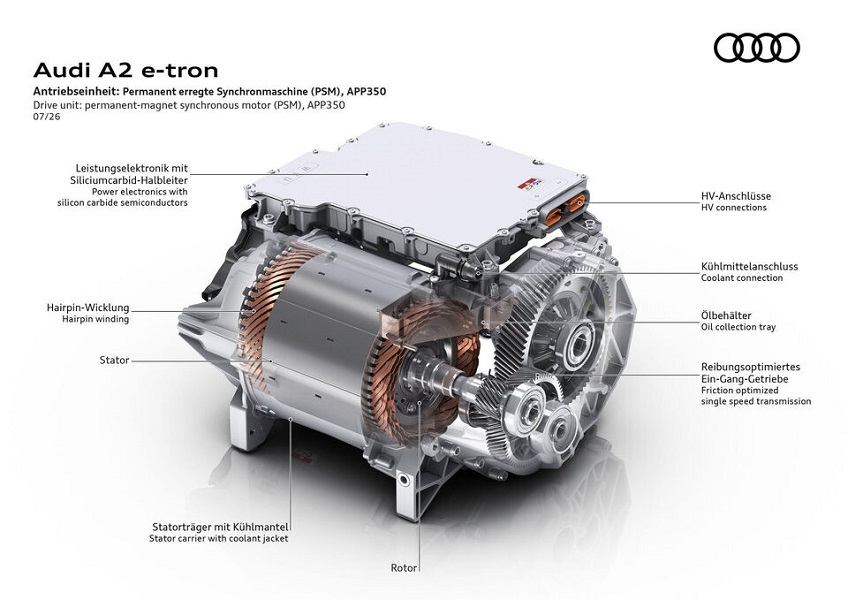
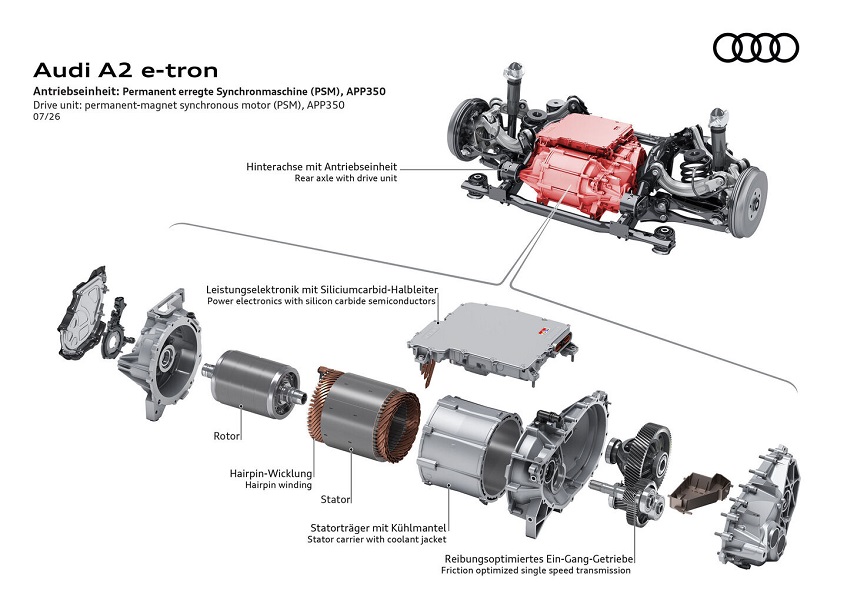
Illustration – Audi A2 e-tron – Drive unit: permanent-magnet synchronous motor (PSM), APP350 – The transparent illustration of the APP 350 shows an overview of its main components and features.
Transmission
The compact, lightweight transmission in the Audi A2 e-tron2 also contributes to higher efficiency through technical refinements. Depending on the performance level, the APP350 in the Audi A2 uses two gear ratios: i=10.21 at 125 kW and 140 kW, and i=11.53 at 170 kW.
The gear ratio selected for each motor variant keeps motor speeds in the most efficient ranges of the characteristic map, further reducing consumption in everyday driving.
The gear teeth are also finished by fine machining, which produces particularly smooth tooth flanks. This reduces friction losses in the transmission and further increases the drive’s efficiency.
This fine machining also allows the use of a specially developed, low-friction transmission oil with very low viscosity. Combined with optimized oil routing in the transmission, this significantly reduces churning losses in the gear set.