













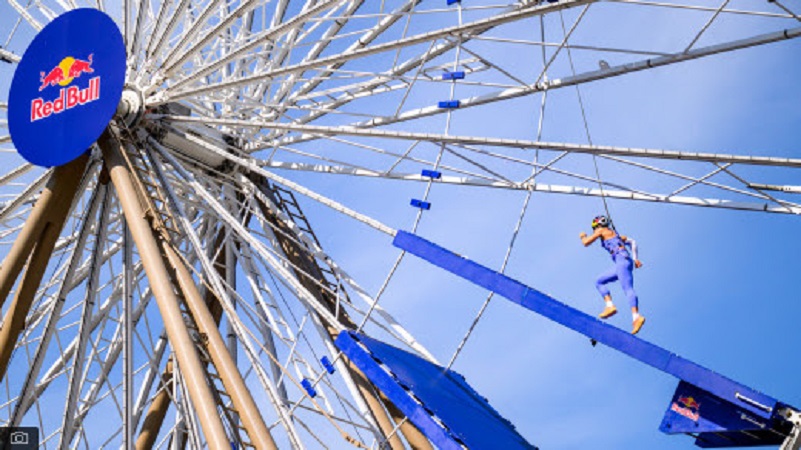
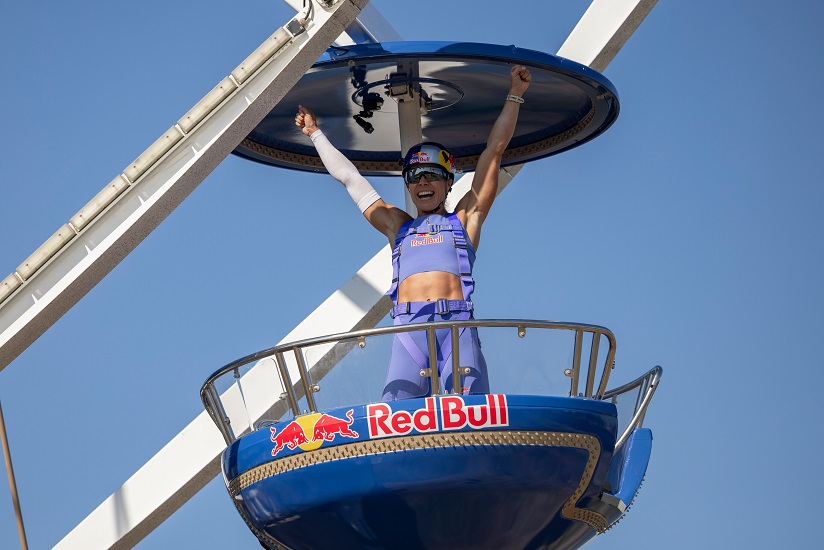
Red Bull athlete Ida Mathilde Steensgaard (Denmark) completed the first-ever rotating obstacle course built inside a Ferris wheel on July 14, 2026, finishing it in 3 minutes and 33 seconds. Set on a specially adapted 30m high structure at Tysklandskaj, a waterfront district in Odense, the feat challenged the Obstacle Course Racing (OCR) and HYROX athlete to clear six obstacles before the wheel made one full rotation.
As the Ferris wheel turned around her, Steensgaard appeared to stay at the same height, creating the illusion of running through a course suspended in place.
The former OCR World Champion needed 4 attempts to land the feat, combining grip endurance, speed, balance, and precise transitions on the moving course, with adverse weather and a limited rehearsal window preventing her from linking all the obstacles in one continuous run before feat day.
Context
Steensgaard’s Ferris wheel project turned a normally fixed fairground structure into a moving obstacle course, with transitions, climbs, traverses, and jumps placed around the wheel. Unlike a standard OCR setup, the challenge required Steensgaard to adapt to rotation, height, wind exposure, and shifting balance points while moving from one section to the next.
The project also formed part of Steensgaard’s return from a shoulder injury, following targeted shoulder training and rehabilitation support from the Athlete Performance Centre to build stability, improve resilience and prepare for the demands of the course.
Key Facts
- Challenge/Event: Ida Mathilde Steensgaard’s Ferris Wheel
- Athlete: Ida Mathilde Steensgaard, Denmark – Red Bull athlete, OCR and HYROX
- Achievement: First-ever rotating obstacle course completed inside a Ferris wheel
- Completion Time: 3 minutes 33 seconds
- Attempts Needed: 4 attempts
- Date of Feat: 14 July 2026
- Location: Tysklandskaj, Odense Havn, Odense, Denmark
- Ferris Wheel Height: 30 m
- Ferris Wheel Diameter/Width: 27 m/2.5 m
- Obstacles Completed: Six obstacles plus start, finish and transition sections
- Terrain/Structure: Moving Ferris wheel, suspended obstacle elements, transition steps, dockside setup
- Safety Measures: Certified stunt and fall-arrest harness, overhead safety system supported by a mobile crane, dedicated safety personnel, obstacle padding, and impact-mitigation measures
- Physical Preparation: Running volume, full-body strength, rehabilitation, HYROX-specific conditioning, Ferris wheel-specific strength, obstacle course racing training, and motion-sickness sessions
Route and Performance Overview
- Gondola Exit/Access Climb & Transition Steps: Steensgaard started and finished the course from the gondola access point, where the key challenges included maintaining secure footing, avoiding contact with the structure, and moving efficiently into the course. Transition steps were added to the wheel to support Steensgaard’s movement between levels.
- Monkey Bars: A succession of bars stretched out from the centre of the wheel, creating the first major grip sequence of the course. Steensgaard had to manage fatigue, pendulum movement, and hand placement while moving around each beam.
- Rope Climb: Steensgaard climbed from one spoke of the wheel up to the next using a rope positioned outside the wheel, combining grip strength, rope control, and shoulder stability.
- Sprint to Beams: Jumping beams placed after the rope climb shifted the challenge towards speed and lower-body movement, requiring accurate foot placement and balance on the rotating structure.
- Climbing Wall: A blue climbing wall with custom holds installed on one section of the wheel sent Steensgaard laterally across the structure, shifting the emphasis back to upper-body strength, foot placement, and controlled movement.
- Reverse Pull-Up Traverse: Steensgaard ran, jumped, and turned to grab the bars, then completed a reverse monkey-bar movement before muscling herself up to the next level.
- Jump to Net: The final obstacle involved a leap from the platform to the net, followed by a transfer around the beam and the last stretch back to the gondola.
Safety measures
The challenge was carried out with Steensgaard secured at all times in a certified stunt and fall-arrest harness connected to an overhead safety system supported by a mobile crane. Dedicated safety personnel managed the system throughout the activity, while obstacle padding and impact-mitigation measures were installed where required. Additional protective equipment was available during rehearsals and validation sessions.
Physical Preparation
Steensgaard’s preparation ran from early May to late June and was built around two training cycles, her return to full strength after a shoulder injury, and the HYROX World Championships on 18–19 June. With no way to fully practise the challenge on a moving Ferris wheel, her programme combined training at the Red Bull Athlete Performance Center in Salzburg, Austria, with endurance, running, full-body strength, shoulder rehabilitation and HYROX-specific work, alongside two weekly Ferris wheel strength-specific sessions.
In the final ramp-up from 15–27 June, the programme became more specialised, adding three weekly obstacle-specific sessions and two motion-sickness sessions while maintaining endurance, strength, shoulder rehabilitation and Ferris wheel-specific training.
Quotes
Ida Mathilde Steensgaard, Two-Time Obstacle Course Racing Champion & HYROX E15 Athlete:
“I would say more challenging than expected for sure. There are so many elements in this attempt, like the speed, the obstacle, the timing, the endurance element, the grip, everything. And most of all, the fear. Just so many things in one. A lot of it was trying to find a good speed for the wheel because it could go at different speeds. That was a big thing. It was also a design process, how you make obstacles that can turn upside down. It’s quite complicated. But then also just, I think I was really surprised because it’s a lot of speed and technical obstacles, and there was just no break. It was just the endurance element, like my lungs felt like they were being ripped apart.”
[On the most complex obstacle] “The reverse monkey bar – it’s one of the last obstacles, and also one of the most demanding ones, upper body-wise, and also fear-wise, because you’re really hanging. You need to make a big jump out to the bar. You’re hanging mostly in your upper body. You’re just really tired, and then having to make it up and over, and running back towards the last obstacle. That one really took a bit of bravery and power.”
“Since I was a little child, I have always loved climbing things – trees, playgrounds, you name it. As I got older, I rediscovered that love through Obstacle Course Racing, running and jumping through endless obstacles. World’s Toughest Playground was a big highlight for me, where I built the ultimate 300-metre obstacle course for myself, and I was so happy to see how many people connected with that project. A few months later, I celebrated New Year’s in Budapest, where I saw a huge Ferris wheel and thought, ‘Could I combine my childhood obsession with climbing things with my OCR skills?’ For me, this project is the perfect combination of what I have always loved doing and what my adult life has taught me.”
Leon Kofoed Andersen, Coach & OCR World Champion: [ahead of the final attempt] “Everything is moving, and everything has to be done very, very fast. These obstacles are not easy at all. I think the most difficult element, and the part that is really hard to see on camera, is how fatiguing it is for Ida. She has to move very fast and very aggressively; otherwise, she can’t make it all the way around the Ferris wheel. She’ll be eaten by the Ferris wheel, and we don’t want that.”
Why It Matters
Completing a rotating obstacle course inside a Ferris wheel marks a new application of obstacle racing skills outside a traditional race environment. The feat combined OCR-specific grip strength, HYROX-style conditioning, balance, injury resilience, and technical adaptation on a moving structure, creating a performance challenge that was shaped as much by timing and stability as by physical power.
The result also shows how obstacle racing skills can be transferred into engineered environments, where athletes must solve movement problems under changing mechanical and environmental conditions.
About the Athlete
Ida Mathilde Steensgaard is a Red Bull athlete from Denmark specialising in Obstacle Course Racing (OCR) and HYROX. She is a two-time OCR 3K World Champion, winning the title in 2022 and 2023, and finished eighth in the HYROX Elite 15 Women’s Pro division in 2026, while also holding the Danish Pro record.
Known for combining grip strength, technical obstacle movement and high-output conditioning, Steensgaard has built her career across race formats that demand speed, endurance, power and precision. Her background in OCR and HYROX gives her a rare competitive profile, bridging obstacle-specific technique with hybrid fitness performance.