












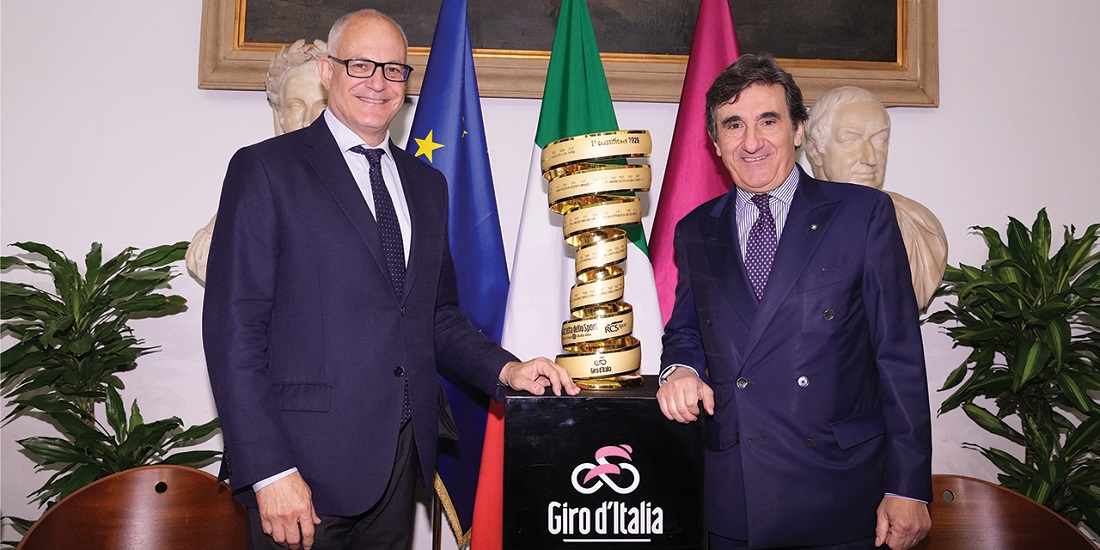
For the eighth time in its history—and the fourth consecutively—Rome will host the Grande Arrivo of the Giro d’Italia. The last stage of the 109th edition of the Corsa Rosa, together with all the related activities, was presented today at the Protomoteca Hall on Capitoline Hill.
Attendees included Rome Mayor Roberto Gualtieri; RCS MediaGroup President Urbano Cairo; Rome Councillor for Major Events, Sport, Tourism and Fashion Alessandro Onorato; RCS Sports & Events CEO Paolo Bellino; La Gazzetta dello Sport Director Stefano Barigelli; and Vincenzo Nibali, winner of two Giro d’Italia titles (2013 and 2016), alongside numerous institutional representatives, media, and partners of the Corsa Rosa.
Roberto Gualtieri, Mayor of Rome: “We are proud that Rome will once again host the Grande Arrivo of the Giro d’Italia, for the fourth consecutive time. This confirms an increasingly strong bond between the Capital and one of the country’s most beloved sporting events, which every year brings extraordinary images of our city to audiences around the world. We can look forward to 131 kilometres of excitement along a route that will start from Ostia, Rome’s seaside district, and pass through some of the city’s most iconic landmarks, including the Colosseum and the Baths of Caracalla, before reaching the final finish line at the Circus Maximus. It will be a day of celebration accompanying the race and once again showcasing the energy and beauty of the Capital to millions of people”.
Urbano Cairo, President of RCS MediaGroup: “Bringing the Grande Arrivo to Rome for the fourth consecutive year means having built something solid, recognizable, and increasingly appreciated at an international level, and this is a great source of pride for us. The Giro is a story of Italy, and there is no better setting than the Eternal City to conclude this long journey through the territories of our country. Alongside the race, the numerous side events will turn this occasion into a true celebration of sport and participation. The Giro d’Italia continues to grow also thanks to such important partners, and Rome today stands as one of its strongest and most prestigious symbols”.
Alessandro Onorato, Councillor for Major Events, Sport, Tourism and Fashion of Rome: “For the fourth consecutive year, we are proud to host the final stage of the Giro d’Italia. What was once a major novelty has now become the norm: this is a victory for our city. We have proven to be reliable and efficient, rising to the challenge, and now we want the Grande Arrivo here to become a tradition. It is not only a sporting event, but a popular celebration that involves the whole of Rome, from the historic centre to Ostia, also thanks to initiatives such as the free ‘Pedalata Rosa’ ride with thousands of families, free shows in Ostia, and tangible legacy projects for the community: this year we will donate dozens of bicycles and helmets to children in foster homes. The Giro d’Italia promotes a positive image of Rome, providing great visibility with millions of television viewers worldwide, and above all it generates significant tourism and economic benefits: according to estimates by Ifis Bank, the economic impact on the Rome area is valued at over €100 million for each edition”.
Paolo Bellino, CEO of RCS Sports & Events: “Rome has once again chosen to embrace the Giro d’Italia, driven by the strong figures that an event of global scale generates year after year. Data from the Ifis Sport survey clearly demonstrates this: we are talking about a total economic impact of €2.1 billion and a steady growth in spectators, with over 2.3 million live attendees. Thanks to its extensive worldwide coverage, the Corsa Rosa reaches more than 18 million international viewers, in addition to hundreds of thousands of people lining the roads. In this context, the Eternal City becomes the ideal stage to perfectly crown an international event of extraordinary value, capable of generating tangible and lasting benefits for the local area”.
Stefano Barigelli, Director of La Gazzetta dello Sport: “Rome is increasingly becoming a true sports capital. Hosting international events such as the Six Nations, the Internazionali d’Italia tennis tournament, and the Giro d’Italia final stage is the result of a significant cultural transformation of the city. Public participation in the final stage has become increasingly active and has grown with each edition, which is essential. It will bring numerous benefits that will be seen in the years to come”.
Vincenzo Nibali: “Rome is a city that always delivers unique emotions, and it is wonderful that the Giro d’Italia will once again conclude in such a magnificent setting. I have never had the pleasure of finishing the Corsa Rosa here, and I regret that. However, it has been great to witness the evolution of the relationship between the city and the Giro d’Italia, and May 31 will undoubtedly be another spectacular day”.
The Route
The final stage features an approach from the start in Roma-EUR to the first pass over the finish line, reaching the coast in Ostia, and going back to the start area, followed by a closing circuit within the Capital. The riders will race 8 loops of a 9.5 km circuit on the streets of Rome (wide, with some traffic dividers). Short undulations are interspersed with long straight sections, connected by sometimes tricky bends. The road surface is mostly tarmac, with some short stretches over road pavers (“sanpietrini”).
Final kilometres
There are just a few mild bends in the final kilometres. The home straight is 350 m long, on 8 m wide tarmac. Halfway through the last km, the road has a 5% gradient. – www.giroditalia.it