















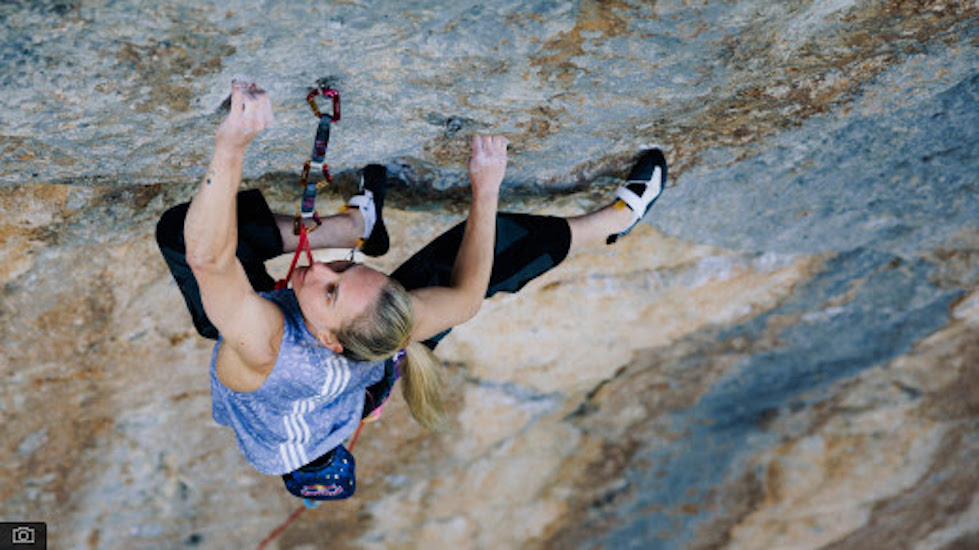

Two-time Olympic champion Janja Garnbret became the first woman to complete the Bibliographie (9b+) ascent at 2000m in Céüse, France, on Saturday, June 6. The achievement saw her join just five other climbers and become only the second woman to conquer a route of that difficulty, which sits one level below the current highest grade in climbing, 9c. The feat emphasised the need for commitment, persistence, and, above all, patience. Here is all you need to know:
– Garnbret broke through on the international circuit with Lead gold at the 2016 World Championships and has gone on to win a further nine world titles in Bouldering, Combined, and Lead, with the Slovenian making history as the first woman climber to win Olympic gold at Tokyo 2020 before adding another gold at Paris 2024.
– Before taking on the 9b+ Bibliographie route, her highest graded redpoint route was a 9a in 2017 in Santa Linya, Spain, while she is also the world’s first female climber to onsight an 8c (5.14b) sport climbing route (Fish Eye, Spain) in 2021.
– The 27-year-old knew going into this huge challenge that she would need to be at the peak of her powers after an impressive winter training block to tackle one of the most historic and iconic limestone venues in sport climbing.
– Located in the French region of the Hautes-Alpes, Céüse has long been considered one of the most historic crags, renowned for its high-quality limestone and world-class endurance routes.
– Characterised by intricate body positioning, several demanding cruxes high above the ground, and sustained resistance climbing, there is a reason Bibliographie has seen only a handful of ascents until this day.
– Only five other people had successfully climbed the 35-metre route before her, which was bolted by American Ethan Pringle in 2009 and first climbed by Germany’s Alexander Megos in 2020.
– Originally graded 9c by Megos after 60 days of trying, the route was later proposed at 9b+ by Italian Stefano Ghisolfi after the second ascent – a consensus that has since been widely accepted.
– Ahead of the ascent, Garnbret revealed: “I’m not doing this to prove anything. I just love climbing, but I want to inspire the next generation not to be afraid of the grade. It doesn’t matter if it’s a man’s or a woman’s route – it’s a route!”
– Garnbret, who has also set a record number of sport climbing World Cup victories in her career, made five trips to the site knowing she needed composure from the opening moves to the final anchor.
– She revealed: “I only had good conditions on about five days. Otherwise, it was either very hot and slippery or very cold, and my fingers would go numb. On two of those good-condition days, I reached a new high point, and on the third, I sent it. That’s the game when you climb outside.”
– On Saturday, temperatures hovered around 15°C – cooler than on previous days. A strong wind swept across the wall throughout the afternoon, keeping both the air and the limestone cold and creating the friction needed for the demanding sequences.
– Garnbret started with the easier section graded around 8a+/8b, then a 17-move-long section and the first crux, which she graded around 9a.
– After that, she launched into the second 9a crux of about 20 moves, and then she finished off the ascent with a 7b section, reaching the top of the route at approximately 4:30 pm, after a climb lasting around 15 minutes and, in total, more than 80 moves.
– She enthused: “Today was just perfect. It was super windy, and the rock was cold and sticky. That’s exactly what I needed for the send. When the send happens, everything feels smooth, everything feels perfect. You almost don’t feel what you’re climbing. In all the previous tries, there was a lot of falling on the crux and the upper crux. Nothing came together, nothing clicked. At the same time, you have doubts, like: ‘Will I ever do it?’ So when it finally happens, it’s an incredible feeling. You remember all the work you’ve put in, all the commitment, all the patience. Today, my heart feels very full.”
– Crucially, Garnbret switched up how she approached her successful feat. She said: “I felt really good today. Already during the warm-up, I felt like I was flying. I told myself: ‘It’s cool, it’s whatever, just climb like you normally do in a training go.’ And that’s what I did. But at the same time, I was fully locked in. I wasn’t letting it go, and I wasn’t letting it slip this time. Honestly, I was just enjoying it.”
– The achievement needed both a strong physical condition as well as a rock-solid mental approach. She revealed: “The challenge was mental, because I’m a very impatient person – I want everything now. So for me, projecting has always been really hard. This route required a lot of commitment: going up, trying all the time, failing, failing again and again, until I finally succeeded. It taught me that, with a calm mind and patience, anything can happen. Never count yourself out.”
– Asked what her advice would be to young climbers, she replied: “Believe in your dreams, even if they feel out of reach. Dream big, go for it, and never give up. This route lit a fire in me. It made me feel something special, and I kept coming back to it. It definitely helped me become a better athlete and a better climber.”
– As well as dreaming up other new projects, Garnbret can now turn her attention back to preparation for the next 2028 Olympic Games in Los Angeles, with the upcoming World Cup event in Innsbruck a chance to break the 50-victory barrier.